
Teaching Day 2023
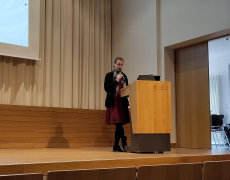
This year’s Teaching Day took place on November 22. This year, our student senator, Katrin Katzenmeier, had the opportunity to explain the challenges students face to the deans of studies and other interested parties. She focused primarily on the enormous workload students face and how the digitization of teaching could help alleviate it.
Afterward, questions from the audience were addressed. One question in particular stood out: “What should a healthy academic experience look like?” The call by some faculty members for functional and user-friendly streaming equipment in all lecture halls was also well-received.
You can read the speech below:
Dear audience,
I am pleased to represent all students here as a student senator and as a spokesperson for the AStA.
I am not speaking only for the students in my department when I say: I am overburdened.
Like so many students these days. The reasons for this are pretty easy to sum up: it starts with the 40 hours a week we spend on a full-time degree program. On top of that, many of us have to work part-time. To put it in numbers: 63%, according to the DSW. That leaves no time left for volunteer work in clubs, social organizations, or here at the university. Sports, art, culture. Everything that contributes to personal development simply falls aside. This is not only a physical but also a psychological strain that is underestimated, even downplayed, by many non-students.
All too often we hear: “You’re supposed to study, not work!”
We… agree. But we’d also like to have a roof over our heads, and the rent doesn’t pay for itself. Refrigerators these days can do the shopping for you, but unfortunately they can’t pay for it.
Not all students are lucky enough to be supported by their parents. On the contrary: three-quarters of students who no longer live with their parents were at risk of poverty last year. That’s according to a survey by the Federal Statistical Office. And the situation hasn’t improved since then. On top of still-high energy prices, we’re facing rising inflation and looming cuts to BAföG. We have no choice but to work alongside our studies.
So many take the obvious route and become student assistants. That way, you can learn something for your own studies while you work.
But let’s take a look at the numbers: Here at the university, we student assistants earn €12.48 an hour—and that’s only been the case for a short while. On top of that, we don’t know if we’ll get a job again next semester, for example as a teaching assistant, since we’re just moving from one temporary contract to the next and depend on the department having enough money to fund student assistants.
At Aldi, on the other hand, as a regular part-time employee, I earn €14 an hour, plus Christmas and vacation bonuses, and have a permanent contract. I even benefit directly from the employee discount when I shop.
And the departments are still surprised that they can’t find any more teaching assistants? When their only argument is that it benefits their own studies? Student employees are an essential part of good teaching. Without teaching assistants, we all end up in lecture hall exercises that merely regurgitate the lecture in an understandable way. Our academic success depends to a large extent on dedicated tutors who are willing to work overtime when trying to explain a topic that the professor failed miserably to cover in the lecture.
But students don’t just work for the university in exercise sessions. Who sits at the service desk in the ULB? Students. Who helps the IT departments of all the research groups? Students. Who makes sure the Materials Testing Institute or the linear accelerator keeps running even at night? That’s right! Students.
As long as student employees at the university are not taken seriously for the essential contribution they make to research and teaching, but are instead viewed as resources—as cheap labor to tackle problems—the shortage will not change. Nor will our workload!
Did you know that you can’t sit in a lecture if you have to work at the same time? At least not until we do more intensive research on cloning here.
And yet the solution would be so simple: digitization.
It’s not without a certain irony that we want to talk today about artificial intelligence and its potential for teaching, when some professors can’t even manage to upload learning materials to Moodle. COVID-19 has shown the advantages of e-learning. COVID-19 has also shown that digitization is more than just making PowerPoint slides available online. For two years, we were able to stream lectures and post recordings online. Yet as soon as we returned to in-person classes, the cries for overhead projectors began again.
During the pandemic, we were forced—or, thank goodness—to break down barriers. Only to take a step backward now? Please tell me how students are supposed to successfully complete their studies without online learning materials if they have to work part-time? If they have to care for sick parents at home or look after their children? If depression prevents them from entering crowded lecture halls or even leaving the house?
When students talk about digitalization, they want at least enough learning materials—made available online—to complete their studies. Videos, lecture notes, and supplementary practice materials. Not overloaded PowerPoint slides that aren’t made available until days after the lecture and are then impossible to follow.
But let’s dare to dream a little further about all the possibilities digitalization could still offer… Interactive lectures made more engaging by digital tools, rather than a lecturer who literally reads the textbook aloud. Simulations that help students visualize a problem at home, rather than dry, tedious calculations they’ll never need again. Online quizzes, short educational videos, interactive apps for self-study. The possibilities are endless, and yet we’re still stuck in dry, blackboard-based lectures from the last century. There’s no point in discussing the benefits of AI for teaching if we’re still forced to hand in assignments written by hand on paper.
But whenever we criticize the format of a lecture, people immediately invoke so-called academic freedom, which is supposedly protected by the Constitution. The fact is, however, that official or organizational requirements can be established to ensure educational objectives are met. This implies not only the possibility but the obligation to take measures that enable students who cannot be physically present to participate in instruction. Whether because they are employed, because they are caring for family members, or because they are involved in volunteer work. Because it represents an unreasonable additional time commitment, or because their studies have already taken such a toll that they are no longer mentally able to leave the house or even their bed. All of these are pushed aside by the “freedom of teaching”!
But will anything ever change?
It’s impossible to say for certain. What can be said with certainty, however, is that it will definitely not be a committee, a commission, or a non-binding recommendation that will revolutionize teaching at TU Darmstadt on a large scale. Here and there, some teaching assistants will pull an all-nighter—for which they will, of course, receive no compensation—so they can bring a few courses they’re responsible for up to 21st-century standards. But the likelihood that this won’t even outlast the next professor—who will want to do everything completely differently anyway—is high. After all, professors know what good teaching is.
Only when professors lead by example and actively expect all professors at TU Darmstadt to embrace and adopt this new level of digital technology will we truly have good teaching.
Thank you very much for your attention.